
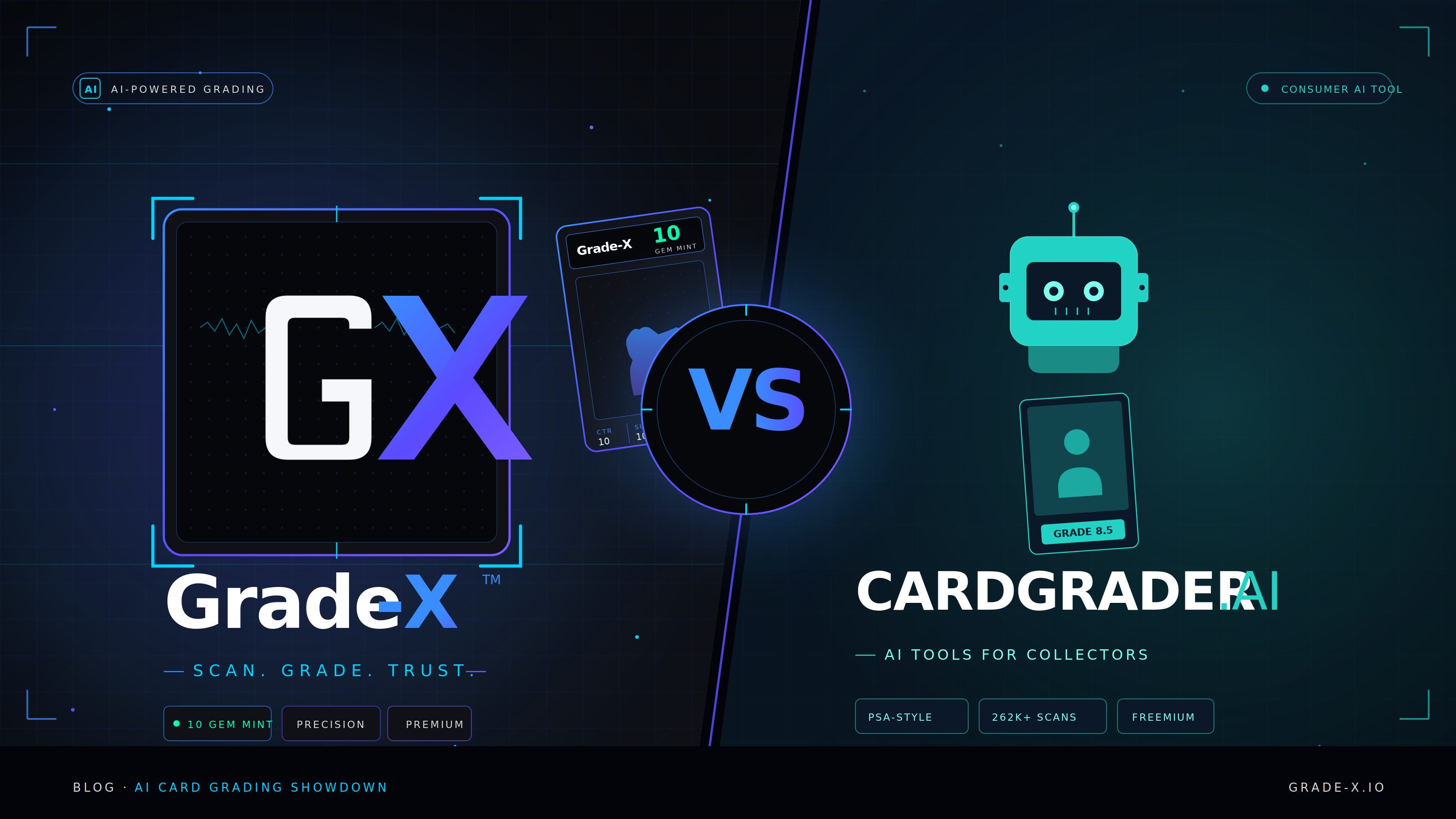
If the broader AI grading category is split between "fast graders" and "analysis tools," this comparison is the one that matters for collectors who already know they want analysis. Gradex.io and CardGrader.ai are the two strongest entries in the analysis-first tier — both go beyond a simple PSA grade prediction to give you condition reports, market data, and decision-making context. But they do it in fundamentally different ways, and the right choice depends on how you actually interact with your collection.
This is the post you read when you've already decided you want more than CardGrading.app's quick scan, and you're trying to figure out which deeper tool fits how you actually collect. We'll compare analysis depth, market data, supported cards, the eBay-listing question, the conversational AI question, and the specific scenarios where each app earns its keep.
What Each App Actually Is
Gradex.io is an AI card scanning and grading app built around in-depth analysis. Every scan returns a predicted PSA-style grade, full sub-grades, a condition explanation, market value modeling across grade tiers, and grading ROI calculations. It's positioned as the analytical brain for collectors who treat their cards as a portfolio.
CardGrader.ai is a similar AI grading platform with a distinctive twist: a conversational AI assistant called "Carl" that lets you chat about your card. You can ask Carl things like "what if the centering was better?" or "show me recent PSA 9 sales for this card," and the app responds with contextual data. It also includes a full eBay listing automation feature — go from scan to listed in a few clicks.
Both apps support sports cards, Pokemon, Magic: The Gathering, Yu-Gi-Oh!, One Piece, and Lorcana. Both pull market data from real-time eBay sales. Both offer detailed sub-grade breakdowns. The differences are in how they present that information and what surrounding tools they bundle.
Side-by-Side Feature Comparison
| Feature | Gradex.io | CardGrader.ai |
|---|---|---|
| AI grade prediction | PSA-style 1-10 | PSA-style 1-10 |
| Sub-grade analysis | ✓ All four pillars | ✓ All four pillars |
| Conversational AI | Structured Q&A | ✓ "Carl" chat assistant |
| ROI / grade-vs-sell math | ✓ Built-in | ✓ Available |
| Real-time eBay data | ✓ | ✓ |
| Direct eBay listing | External | ✓ Built-in |
| Collection portfolio | ✓ Full tracking | ✓ Digital binders |
| Card type breadth | Sports + TCG | Sports + TCG |
| Best for | Analysis-first decisions | Scan-to-sell workflow |
The Analysis Question: Structured vs Conversational
This is the philosophical fork in the road. Both apps give you depth — but they deliver it differently.
Gradex.io organizes its analysis as a structured report. When you scan a card, the output reads like a professional inspection: a predicted grade, the four sub-grades with confidence intervals, a written breakdown of which defects pulled the grade down, a market value table showing the card's worth at each grade level, and a verdict on whether grading makes sense given current market conditions. It's clinical in the best way — you can scan ten cards and immediately compare them in a dashboard.
CardGrader.ai delivers similar information but lets you have a conversation about it. After a scan, you can ask Carl questions like "what's the PSA 9 market trend for this card over 90 days?" or "what would the value be if I cleaned the surface?" That's a great experience if you like exploratory analysis — you can poke at hypothetical scenarios and learn about value drivers organically. It's a worse experience if you want to evaluate twenty cards quickly, because chat is inherently slower than a dashboard.
"Gradex shows you the answer. CardGrader lets you ask questions about it. Which one wins depends on whether you want speed or curiosity."
The Selling Question: One Platform vs Best-in-Class
CardGrader.ai's most distinctive feature is its end-to-end workflow. After you grade a card, you can use the app's automation to list it on eBay in a few clicks — title, photos, description, and pricing pulled in from the scan and market data. For collectors who actively flip, this is genuinely valuable. The fewer tabs you have to manage, the more cards you can move per week.
Gradex.io takes a different position. It's deeply integrated with grading decisions but doesn't try to be your selling platform. You'll still go to eBay, COMC, or your marketplace of choice when it's time to list. The trade-off is that Gradex stays focused on what it does best — analysis — without dividing its development effort across a marketplace integration.
Which approach is better depends on your habits. If you list 5+ cards a week, the all-in-one workflow saves real time. If you list a few cards a month, you'd rather have the best analysis tool and use eBay's native interface for the listing itself.
How They Compare on Real Workflows
Feature lists are abstract. Here's how the two apps actually perform across four common collector workflows:
Four Real Scenarios — Who Wins Each
Either app works for a one-card scan. Gradex gives you a faster verdict on whether to grade it. CardGrader lets you explore "what if it's actually a 10?"
Gradex.io wins. Bulk-scan dashboard view makes triage fast. CardGrader's chat interface slows this workflow.
CardGrader.ai wins. Built-in eBay automation cuts listing time dramatically vs. native eBay flow.
Both work well. CardGrader's conversational depth is fun for exploration; Gradex's structured market view is faster for a buy/no-buy decision.
Pricing & Free Tiers
Both apps offer free entry tiers, which is the right approach for any tool that asks collectors to scan their cards. You shouldn't have to pay before you see the quality of the analysis.
Gradex.io's pricing is structured around full collection analysis — your subscription unlocks portfolio-wide insights, not just per-card scans. That model rewards collectors who use the tool as their ongoing collection brain rather than a one-time scanner.
CardGrader.ai's pricing reflects its broader feature set, including the eBay listing automation. Higher tiers are designed for active flippers who'll recoup the cost in saved listing time.
For specific current rates, check each app's pricing page — both update tiers regularly as features evolve. The honest answer is that for serious collectors, both apps are priced reasonably relative to what you'd pay in PSA fees on a single bad submission you avoided thanks to good pre-grading.
Accuracy: The Tie
Here's where the two apps end up in the same place. Both train on professionally graded cards, both use computer vision evaluating the same four pillars (centering, corners, edges, surface), and both converge with PSA's actual grade decisions on most modern cards in good photo conditions. Neither app is meaningfully more accurate than the other on a typical scan.
The bigger accuracy variable is you. Photo lighting, focus, and angle affect AI grading more than the choice of app. Both Gradex and CardGrader provide guidance for optimal photo capture; following it matters more than which logo is on the screen.
The Verdict: Pick Based on Your Endgame
Choose Gradex.io ifChoose CardGrader.ai if
You want clean analysis, fastYou analyze in volume, value structured reports over chat, and want a dedicated tool for grading decisions. You list cards on eBay using eBay directly.You want one tool, scan to saleYou like the conversational AI experience and want eBay listing built into the same app. You actively flip cards and value workflow consolidation.
If you're still on the fence, here's the simplest rule: do you spend more time deciding what to grade, or more time listing what you've already graded? Gradex is built for the first problem. CardGrader is built to span both. There's no wrong answer — there's only the workflow that matches how you actually spend your collecting time.
Frequently Asked Questions
What's the main difference between Gradex.io and CardGrader.ai?
Gradex.io focuses on structured, in-depth analysis with ROI math and full collection insights. CardGrader.ai adds a conversational AI assistant ("Carl") and an eBay listing automation. Both predict PSA-style grades with sub-grade breakdowns.
Which app has better market value data?
Both apps pull from real-time eBay sales and other marketplace data. Gradex.io presents value across grade tiers in a structured table. CardGrader.ai lets you query the data conversationally. The underlying data quality is comparable.
Which is better for Pokemon collectors?
Gradex.io's bulk-scan workflow suits high-volume Pokemon pullers triaging many chase cards. CardGrader.ai's conversational interface is good for collectors exploring value scenarios on individual cards. Both fully support Pokemon.
Do these apps replace PSA grading?
No. Both apps are pre-grading tools. PSA, BGS, CGC, and SGC slabs carry the authentication and resale premium. AI predictions help you decide which cards to send so you don't waste fees on cards unlikely to grade well.
Are either of these apps free to try?
Yes. Both Gradex.io and CardGrader.ai offer free entry tiers so you can test the analysis quality before committing. Paid tiers unlock advanced features like portfolio tracking, deeper market data, and (for CardGrader) eBay listing automation.